The NFL (National Football League) is not just America’s most popular sports league — it is also the most profitable. Every year, the NFL generates more than $20 billion in revenue. But how does the league actually make that much money?
In this post, we break it down in a clear and simple way.
💰 Total NFL Revenue Per Year
The NFL consistently generates $20–23 billion annually, making it the richest sports league in the world.
📈 Over $20 billion in total yearly revenue
🏈 32 teams share league-wide income
💼 Centralized business model ensures stability
📺 TV & Streaming Deals: The Real Money Engine
The largest source of NFL income comes from television and streaming rights.
📡 Long-term deals with FOX, CBS, NBC, ESPN, Amazon, and YouTube TV
💵 Contracts worth over $110 billion across multiple years
📊 National games guarantee massive audiences every week
These deals alone generate billions each season before a single ticket is sold.
🏟️ Revenue Sharing: How Teams Get Paid
The NFL uses one of the most equal revenue-sharing systems in sports.
💰 Each team receives approximately $430+ million per season
🤝 Shared national revenue keeps all teams competitive
📉 Reduces financial gaps between big and small markets
This system is a key reason why the NFL remains financially strong and balanced.
🎟️ Tickets, Merchandise & Sponsorships
Beyond TV deals, the NFL earns massive income from:
🎟️ Ticket sales and season passes
👕 Official merchandise and apparel
🏷️ Sponsorships with global brands
🏆 Super Bowl advertising and events
The Super Bowl alone generates hundreds of millions in advertising revenue.
💎 Team Valuations: Why Owners Keep Winning
NFL franchises are among the most valuable sports teams in the world.
📊 Average team value: $7+ billion
⭐ Top teams valued at over $10 billion
📈 Franchise values rise almost every year
Even poorly performing teams often increase in value over time.
📌 Why the NFL Business Model Works
✔ Strong revenue sharing
✔ Limited number of games increases demand
✔ National media focus
✔ Salary cap controls costs
The result is a league that dominates both the sports and business worlds.
🏁 Final Thoughts
The NFL is not just about football — it is a perfectly engineered business machine. With massive TV contracts, equal revenue sharing, and global brand power, the league continues to generate billions every year.
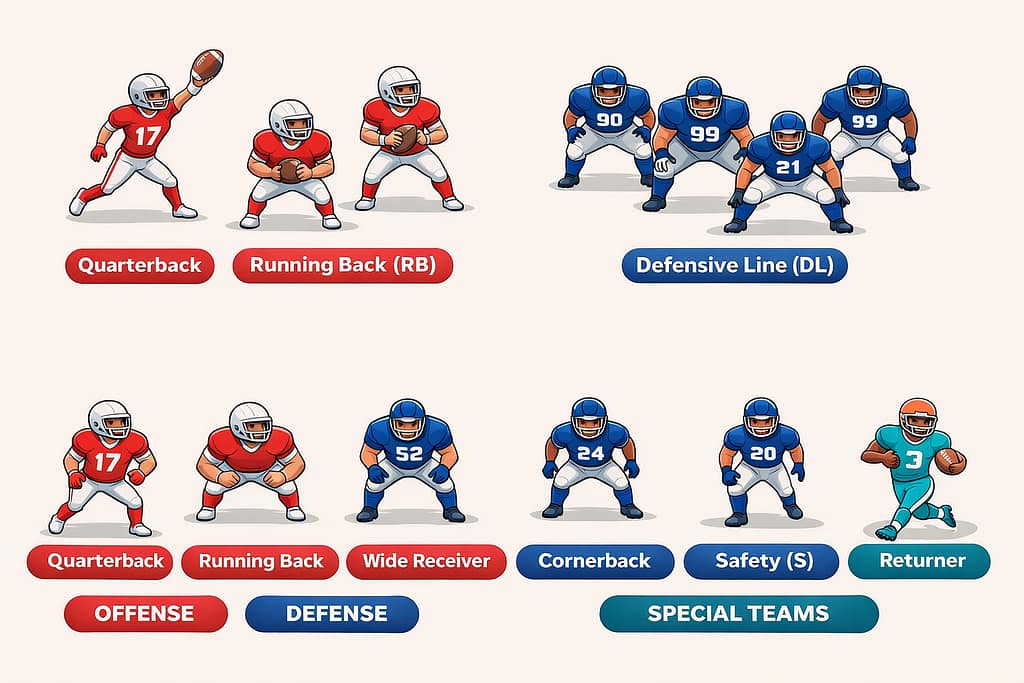
The NFL can feel confusing if you don’t know what each player does on the field. This simple guide explains every NFL position clearly, so anyone can understand the game — even first-time fans.
🧠 OFFENSE POSITIONS
🎯 Quarterback (QB)
The leader of the offense. The quarterback throws passes, reads defenses, and controls the pace of the game.
✔ Passes the ball
✔ Calls plays
✔ Makes split-second decisions
🏃 Running Back (RB)
Responsible for running the ball and catching short passes.
✔ Rushing yards
✔ Pass protection
✔ Receiving from the backfield
👐 Wide Receiver (WR)
Fast players who catch passes and stretch the field.
✔ Speed and agility
✔ Route running
✔ Big plays
🧱 Offensive Line (OL)
Protects the quarterback and opens lanes for runners.
✔ Pass protection
✔ Run blocking
✔ Physical strength
🛡 DEFENSE POSITIONS
💥 Defensive Line (DL)
Stops the run and pressures the quarterback.
✔ Tackles
✔ Sacks
✔ Run stopping
🚀 Linebacker (LB)
The most versatile defenders on the field.
✔ Covers receivers
✔ Blitzes the QB
✔ Reads offensive plays
🕵️ Cornerback (CB)
Defends wide receivers and prevents passes.
✔ Man coverage
✔ Interceptions
✔ Speed and awareness
🧠 Safety (S)
The last line of defense.
✔ Deep coverage
✔ Big hits
✔ Play recognition
🎯 SPECIAL TEAMS
🦵 Kicker (K)
Scores points through field goals and extra points.
🚀 Punter (P)
Kicks the ball away to control field position.
📌 Why Knowing Positions Makes Football More Fun
Understanding positions helps you:
✔ Follow plays faster
✔ Enjoy strategy and tactics
✔ Talk football with confidence
This knowledge turns NFL games from confusing to exciting.
In the long and dramatic history of the NFL, many players have failed to meet expectations. But one name consistently stands above the rest when fans, analysts, and former players debate the worst NFL player of all time.
📌 Why This Topic Still Matters Today
This isn’t just a story about poor performance — it’s a lesson about scouting, work ethic, money management, and how pressure can destroy even the most physically gifted athletes. That’s why this topic remains relevant year after year.
🥇 Drafted #1 Overall — Expectations Were Sky-High
In the 2007 NFL Draft, the Oakland Raiders selected JaMarcus Russell with the #1 overall pick.
📏 Size: 6’6” (198 cm)
💪 Arm strength: Elite (could throw 60+ yards effortlessly)
🏈 College success: National champion at LSU
Scouts believed Russell had franchise quarterback potential. Instead, he became a cautionary tale.
📉 Career Statistics That Shock Fans
Across just three NFL seasons, Russell posted numbers that are historically poor for a No.1 pick:
❌ Career Record: 7 wins – 18 losses
📊 Completion Percentage: 52%
🎯 Touchdowns: 18
🚫 Interceptions: 23
📉 Passer Rating: 65.2
For comparison, the league average quarterback rating during that era was above 80.
🚨 The Real Problem: Work Ethic
Former coaches and teammates later revealed a shocking truth:
🧠 Russell frequently skipped film study
📼 Coaches gave him blank tapes — he claimed he watched them anyway
⚠️ Conditioning issues became obvious mid-season
Talent alone wasn’t enough — and Russell never adapted to the professional level.
💰 Massive Contract, Minimal Return
JaMarcus Russell signed a $68 million contract, with $39 million guaranteed — one of the largest rookie deals ever at the time.
He was released after just three seasons, making him one of the most expensive mistakes in NFL history.
🧠 Why Experts Call Him the Worst Ever
Many players underperform — but Russell checks every box that defines a historic failure:
❌ #1 overall pick
❌ Franchise-altering expectations
❌ Poor on-field results
❌ Lack of effort and preparation
❌ Long-term damage to the team
Even decades later, analysts still use his name as a warning during draft season.
🔄 What the NFL Changed Because of Him
Russell’s failure helped accelerate major changes in the league:
📜 Rookie wage scale implemented
📉 Fewer massive guaranteed rookie contracts
🔍 More focus on mental preparation during scouting
In a strange way, his career helped protect future teams from repeating the same mistake.
📊 Final Verdict
JaMarcus Russell wasn’t the least talented player to ever step onto an NFL field — but he may be the clearest example of how talent without discipline fails.
That’s why, year after year, fans continue to ask the same question:
Was JaMarcus Russell the worst NFL player of all time?
For many, the answer remains a clear and uncomfortable yes.