Floyd Mayweather Jr. is not just one of the greatest boxers of his era — he is one of the most dominant athletes in sports history. With an undefeated professional record, elite defensive skills, and record-breaking earnings, Mayweather redefined what success looks like in modern boxing.
In this in-depth analysis, we break down his full career, fight record, knockouts, titles, and the impact he left on the sport.
📌 Floyd Mayweather Career Overview
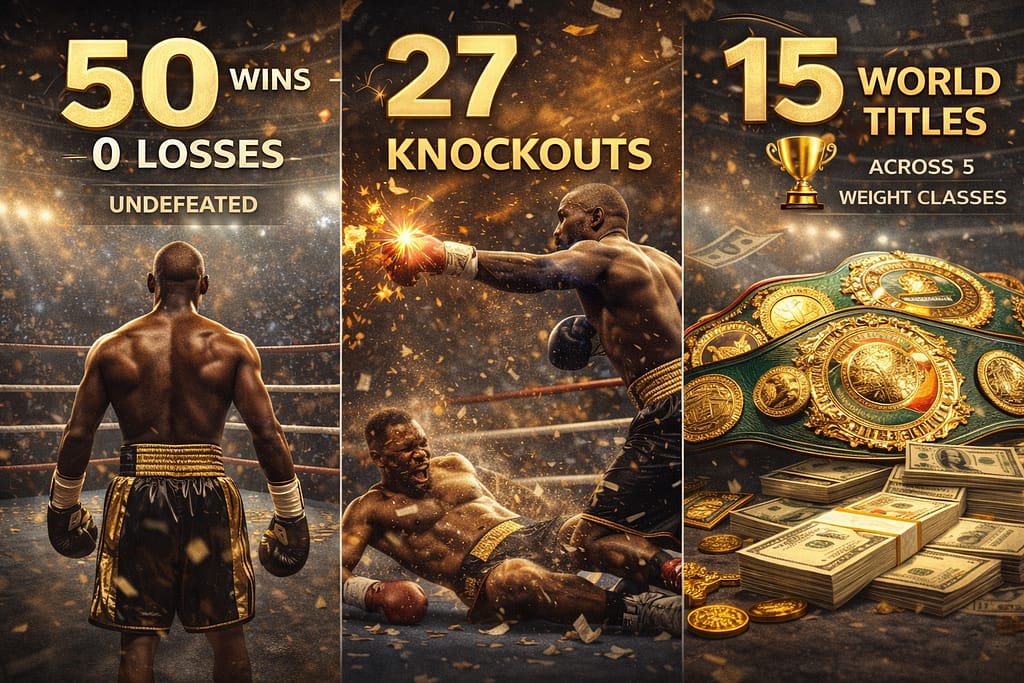
🥊 Professional Record: 50 wins – 0 losses
💥 Knockouts: 27
🏆 World Titles: 15 (across 5 weight classes)
💰 Highest-Paid Boxer Ever
🛡️ Defensive Style: Elite counter-punching & ring IQ
Mayweather’s ability to adapt, read opponents, and control distance made him nearly impossible to beat inside the ring.
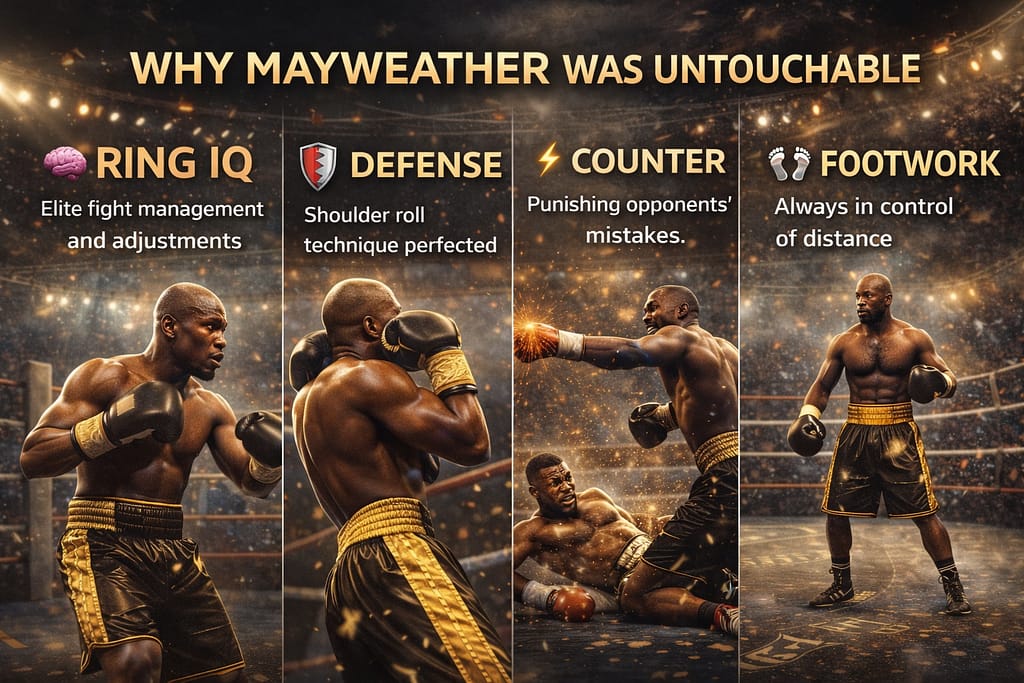
🥊 Fighting Style: Why Mayweather Was Untouchable
Unlike many knockout-focused fighters, Mayweather built his legacy on defense, precision, and intelligence.
🧠 Ring IQ: Elite fight management and adjustments
🛡️ Defense: Shoulder roll technique perfected
⚡ Counter Punching: Punishing opponents’ mistakes
👣 Footwork: Always in control of distance
This style allowed him to dominate aggressive fighters while minimizing damage throughout his career.
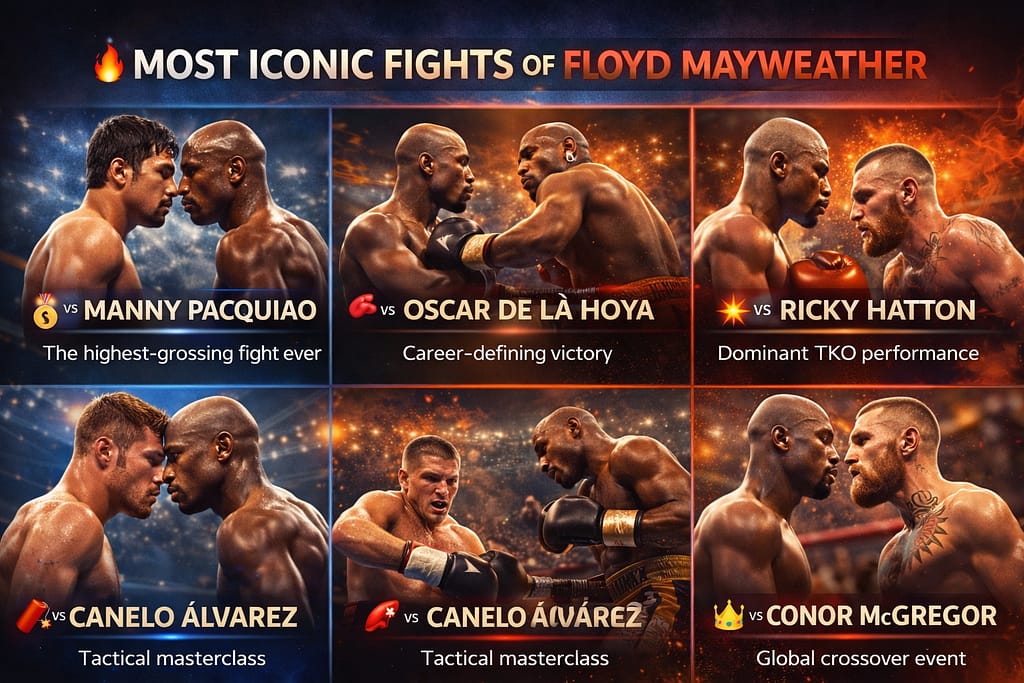
🔥 Most Iconic Fights of Floyd Mayweather
Throughout his career, Mayweather faced and defeated some of the biggest names in boxing history.
🥇 vs Manny Pacquiao (2015): The highest-grossing fight ever
🥊 vs Oscar De La Hoya (2007): Career-defining victory
💥 vs Ricky Hatton (2007): Dominant TKO performance
🧨 vs Canelo Álvarez (2013): Tactical masterclass
👑 vs Conor McGregor (2017): Global crossover event
Each of these fights showcased a different version of Mayweather’s brilliance.
📊 Titles Across Five Weight Classes
Mayweather captured championships from super featherweight to light middleweight, proving his dominance across divisions.
🏆 Super Featherweight
🏆 Lightweight
🏆 Super Lightweight
🏆 Welterweight
🏆 Light Middleweight
This versatility is one of the key reasons he is considered an all-time great.
💰 Business, Fame & Global Impact
Outside the ring, Mayweather became a brand. He controlled his promotions, fight negotiations, and pay-per-view strategy like no boxer before him.
📈 Hundreds of millions generated per fight
📺 Record-breaking PPV sales
🏦 Financial independence from promoters
His influence changed how fighters negotiate contracts and manage their careers today.
📉 Criticism & Controversy
Despite his success, Mayweather’s career was not without criticism.
❗ Accusations of avoiding risky fights early
❗ Defensive style seen as “less exciting” by some fans
❗ Personal controversies outside boxing
Still, results inside the ring speak louder than opinions.
🏁 Final Verdict: Where Does Mayweather Rank All-Time?
Whether fans love or hate his style, Floyd Mayweather’s record is undeniable. Undefeated, financially dominant, and tactically superior, he set a standard that few athletes will ever reach.
Legacy: One of the smartest, most disciplined, and successful fighters in boxing history.
For modern fighters, Mayweather represents a blueprint — not just for winning fights, but for controlling an entire career.
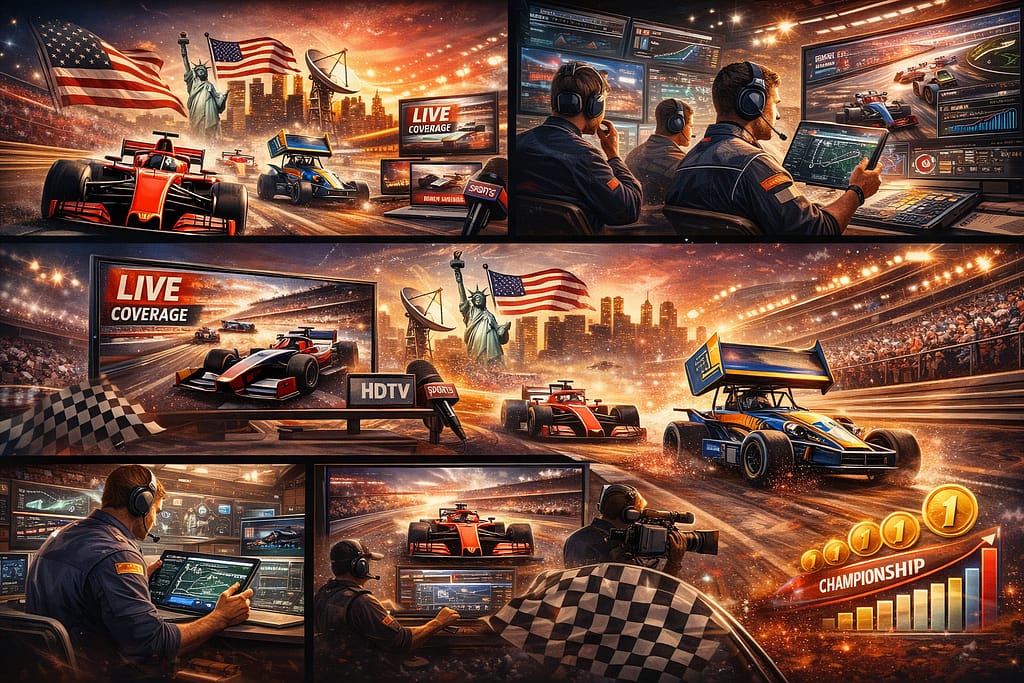
For years, access to live international racing events has been fragmented across platforms. Beginning in 2025, fans will benefit from:
✅ Live coverage of all Grand Prix races
✅ Sprint race broadcasts with expert commentary
✅ High-definition production and modern broadcast technology
✅ Easier access through traditional TV and digital platforms
🚀 Why Sprint Races Matter
Sprint races have quickly become one of the most exciting additions to modern motorsports. Shorter, faster, and more aggressive, they bring:
⚡ More on-track action in less time
🔥 Higher stakes for drivers and teams
📊 Additional championship points
Broadcasting these events live gives fans a deeper connection to race weekends beyond just the main event.
📈 A Strategic Move by American Media
The decision reflects the growing popularity of global motorsports in the U.S. market. With increasing interest driven by younger audiences and digital engagement, this deal positions the broadcaster to:
📢 Expand its sports portfolio
🌎 Attract international motorsport fans
📱 Strengthen streaming and on-demand offerings
🔮 What to Expect in 2025 and Beyond
This broadcast agreement is expected to elevate motorsports visibility across the United States. Fans can look forward to:
🏁 More consistent race coverage
🎙️ Improved analysis and storytelling
🇺🇸 Greater mainstream exposure for global racing series
As 2025 approaches, this move could redefine how motorsports are consumed in America — bringing the thrill of speed, strategy, and competition directly into millions of homes.
The NFL is changing fast. The 2025 season is proving that traditional offensive systems are being replaced by faster, smarter, and more flexible strategies. Teams are no longer relying only on power football — they’re adapting to modern defenses, analytics, and player versatility.
📈 Why NFL Offenses Are Changing So Quickly
Several key factors are driving the evolution of NFL offenses this season:
🧠 Advanced analytics influencing play-calling
⚡ Faster defensive units forcing quicker decisions
📋 Rule changes favoring passing offenses
🎯 Quarterbacks with elite processing speed
Coaches now prioritize flexibility over predictability. If a defense adjusts, offenses respond immediately — sometimes within the same drive.
🧠 The Rise of the “Positionless” Offense
One of the biggest trends in the NFL is the rise of positionless football. Running backs line up as receivers, tight ends act as slot weapons, and wide receivers take handoffs.
This creates mismatches that defenses struggle to cover, especially in man coverage.
🏃 RBs catching 50+ passes per season
🧍 Tight ends lined up outside the numbers
🔁 Constant pre-snap motion
🎯 Quarterbacks Are the True Difference-Makers
In 2025, elite quarterback decision-making matters more than arm strength. The best QBs excel at:
📖 Reading defenses pre-snap
⏱️ Releasing the ball in under 2.5 seconds
🧠 Adjusting protections on the fly
This explains why some teams with average receivers still produce top-10 offenses — the quarterback controls the tempo.
📊 Data-Driven Play Calling Is Taking Over
Analytics departments now influence real-time decisions. Fourth-down aggression, red-zone tendencies, and defensive weaknesses are tracked live during games.
This results in:
📉 Fewer conservative punts
📈 Higher scoring games
🎲 Smarter risk management
Teams that ignore data often fall behind quickly in close games.
🚑 How Injuries Are Forcing Offensive Innovation
Injuries at key positions have forced teams to simplify and speed up offenses. Instead of complex route trees, many teams rely on:
⚡ Quick passes
📦 Packaged plays (run-pass options)
🛡️ Extra protection schemes
This keeps backup quarterbacks competitive and limits defensive pressure.
🔮 What This Means for the Rest of the Season
Looking ahead, offenses that adapt will dominate late in the season. Expect:
🔥 Higher-scoring playoff games
🧠 Coaching adjustments becoming decisive
📊 Analytics-driven upsets
Fans should expect fewer predictable drives and more explosive moments every week.
⭐ Final Takeaway
The NFL in 2025 is faster, smarter, and more strategic than ever. Offensive evolution isn’t a trend — it’s the new standard. Teams that fail to adapt will struggle, while innovators gain a clear edge.
For fans, this means better games, more excitement, and nonstop action every Sunday.
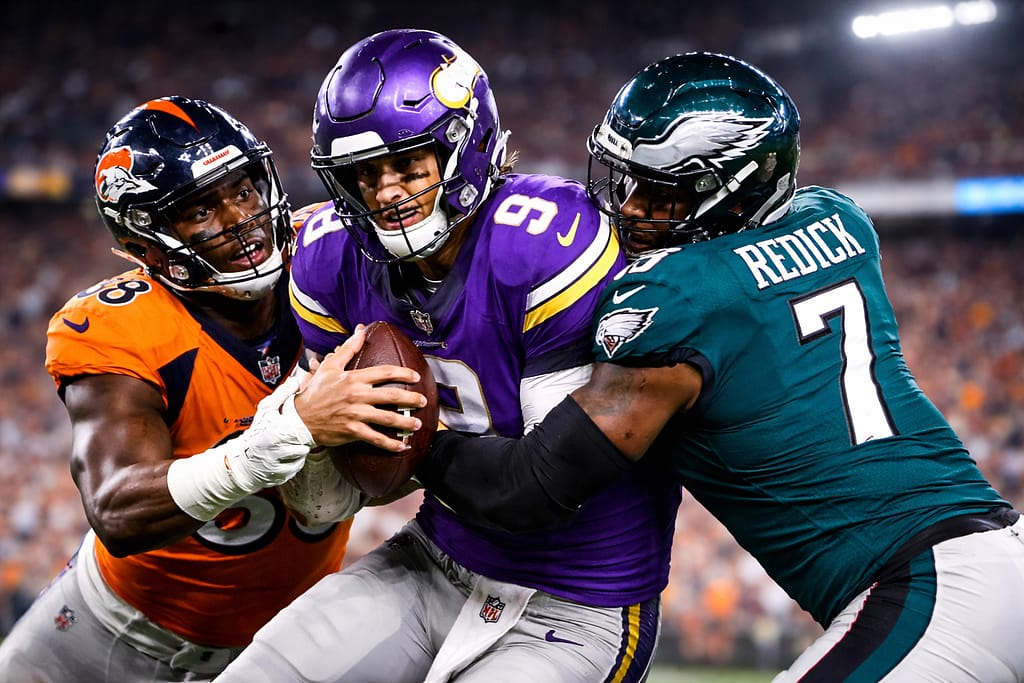
The NFL is entering a new era. Across the league, young quarterbacks are no longer “projects” — they are franchise leaders from Day 1. From playoff pushes to massive contract decisions, the quarterback position is evolving faster than ever.
📈 Why Young Quarterbacks Are Taking Over
Over the past two seasons, teams have shifted their strategies. Instead of relying on veteran quarterbacks late into their careers, franchises are building around young talent on rookie contracts.
This approach has already produced results across multiple conferences.
⭐ Standout Young QBs Making an Impact
Several quarterbacks under 26 years old are already defining the league:
🔥 Dual-threat quarterbacks extending plays with their legs
🎯 Pocket passers with elite accuracy and decision-making
🧩 Leaders trusted to control full offensive systems
These players aren’t just surviving — they’re winning divisions and playoff games.
⚖️ Pros and Cons of Building Around Young QBs
✅ Advantages
💸 Salary cap flexibility
🚀 Faster offensive development
📅 Long-term planning stability
❌ Risks
⚠️ Inexperience in high-pressure games
🩺 Higher injury risk due to mobility
⏳ Short evaluation windows before contract extensions
Teams must balance patience with urgency — a mistake can set a franchise back years.
🔮 What This Means for the Future of the NFL
The league is clearly shifting toward speed, intelligence, and adaptability at quarterback. In the next three seasons, expect:
📉 Fewer long-term veteran contracts
📈 More aggressive rookie QB development
🏆 Super Bowl contenders led by quarterbacks under 28
This evolution is changing not just offenses, but draft strategies, coaching hires, and roster construction league-wide.
📊 Final Takeaway
The NFL’s future belongs to young quarterbacks who can think fast, move faster, and lead immediately. Teams that identify and develop these players correctly will dominate the next decade.
As fans, analysts, and bettors adjust expectations, one thing is clear: the quarterback revolution is already here.
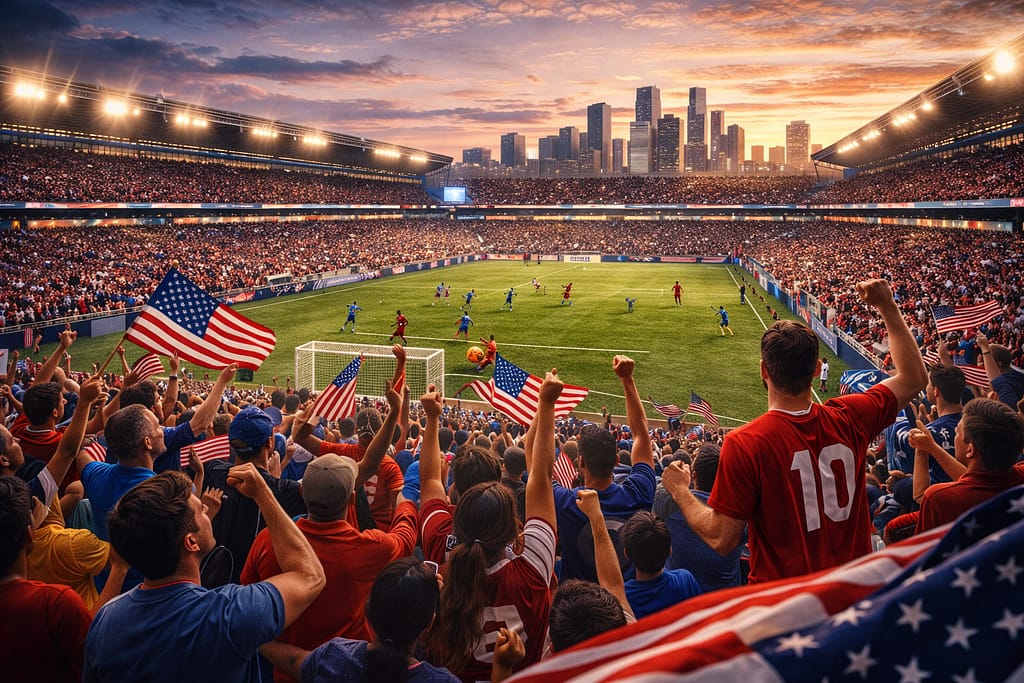
Soccer is no longer a niche sport in the United States. As the country prepares to host the 2026 FIFA World Cup, interest in football (soccer) has reached historic levels across American cities, media platforms, and youth systems.
From packed MLS stadiums to record-breaking TV audiences, soccer is positioning itself as one of the fastest-growing sports in the U.S.
📈 Why Soccer Popularity Is Growing So Fast in the USA
🌍 Hosting the 2026 World Cup alongside Canada and Mexico
📺 Increased TV coverage on major US networks
👶 Massive growth in youth soccer participation
⭐ Global superstars joining MLS teams
These factors combined have created a perfect environment for soccer to thrive beyond traditional American sports like football and basketball.
🏟️ MLS: The Engine Behind Soccer’s Rise
Major League Soccer (MLS) has been the backbone of soccer’s expansion in the United States. Over the last decade, the league has:
🏟️ Built modern, soccer-specific stadiums
💰 Increased franchise valuations dramatically
🌎 Attracted international stars and young talent
Cities like Los Angeles, Miami, Atlanta, and Austin have become true soccer hubs, drawing passionate crowds week after week.
🌎 The Impact of the 2026 World Cup
The upcoming World Cup is expected to be a turning point for American soccer culture.
📊 Millions of new casual fans introduced to the sport
🏆 Increased investment in infrastructure
🎯 Long-term legacy for US soccer development
Analysts predict that post-2026, soccer could rival hockey and baseball in national popularity.
🔮 What Comes Next for Soccer in America?
Looking ahead, the future of soccer in the United States appears stronger than ever:
📈 Continued youth participation growth
⭐ More elite players choosing MLS
📺 Bigger broadcast deals and sponsorships
Soccer is no longer “the sport of the future” in America — it is becoming the sport of the present.
✅ Final Thoughts
With the World Cup approaching and fan interest surging, soccer’s rise in the United States is undeniable. The next few years could redefine the American sports landscape forever.