NFL Playoff Seeding Explained: How the Seeds Really Work (Tiebreakers, Division Winners, Wild Cards)
🏈 NFL Guide • Playoffs • Seeding & Tiebreakers
NFL Playoff Seeding Explained
Every season the same question explodes on search and social media: “How is this team a higher seed with fewer wins?” This post breaks the NFL playoff system down in a way that’s easy to follow—without skipping the details.
⚡ 60-Second Answer
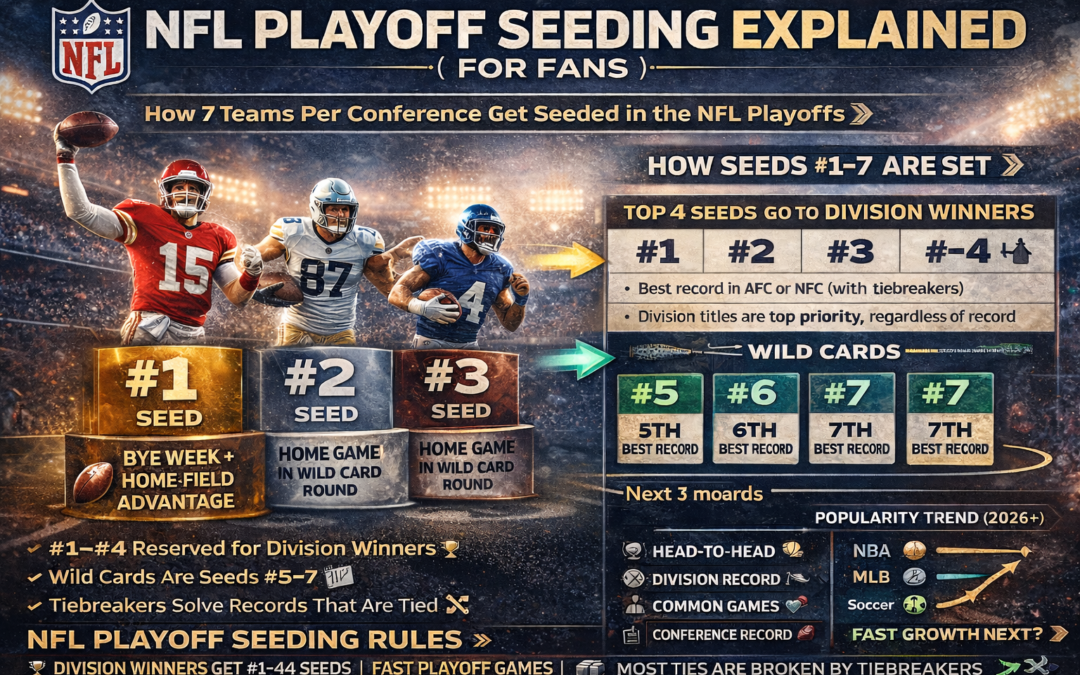
✅ Each conference sends 7 teams to the playoffs.
🏆 4 division winners automatically earn seeds #1–#4 (even if a wild card has more wins).
🎟️ The next 3 best records become wild cards (seeds #5–#7).
🔁 If records tie, the NFL uses tiebreakers (head-to-head, division record, conference record, etc.).
🏠 Division winners host a playoff game in the Wild Card round (seed advantage).
📌 The Basic Rule Everyone Misses
The NFL rewards winning your division. That’s why a division champion can be seeded above a wild card team with a better overall record. It’s intentional: divisions matter.
🧩 How Seeds #1–#7 Are Assigned (Simple Table)
Seed
Who Gets It?
What You Earn
#1
Best conference record (with tiebreakers)
🏆 Bye week + home-field advantage throughout
#2
2nd-best division winner
🏠 Home game in Wild Card round
#3
3rd-best division winner
🏠 Home game in Wild Card round
#4
4th-best division winner
🏠 Home game in Wild Card round
#5
Best wild card record
✈️ Road game in Wild Card round
#6
2nd wild card record
✈️ Road game in Wild Card round
#7
3rd wild card record
✈️ Road game in Wild Card round
🤯 “How Can a Team With Fewer Wins Get a Higher Seed?”
Because seeds #1–#4 are reserved for division winners. If a division is weak, its champion can still take seed #4—while a stronger team from another division becomes a wild card (seed #5–#7).
✅ Quick Example (No Team Names Needed)
Team Type
Record
Result
Division Winner
9–8
Gets a top-4 seed and hosts a Wild Card game
Wild Card
11–6
Can be seeded #5 and must play on the road
This is why fans often feel the system is “unfair”—but it’s a feature, not a bug. The league wants division games to mean something.
🔁 NFL Tiebreakers (The Ones That Usually Decide It)
When two teams have the same record, the NFL uses a step-by-step tiebreaker ladder. Here are the most common ones that decide seeding before it gets weird.
Tiebreaker
What It Means
Why It Matters
1) Head-to-Head
Who won when they played each other?
👊 Direct proof on the field (if applicable)
2) Division Record
Wins/losses vs division opponents
🏁 Division games are weighted heavily
3) Common Games
Record vs the same opponents
📌 Normalizes schedules a bit
4) Conference Record
Wins/losses vs same conference teams
🏈 Seeding is conference-based
5) Strength of Victory
Combined record of teams you beat
💥 Rewards beating better teams
6) Strength of Schedule
Combined record of all opponents faced
🧠 A fairness “backup”
Key tip: Most ties are resolved by the first 3–4 steps. The later ones rarely matter.
🏠 Why Seeding Matters So Much
🏟️ Home playoff games are a major advantage (travel + crowd + routine).
⏳ Seed #1 gets a bye, which can mean healthier players and extra prep time.
🧠 Seeding shapes matchups: #2 vs #7, #3 vs #6, #4 vs #5 in the Wild Card round.
📉 What Fans Think vs Reality (Fast Clarity Table)
Common Belief
Reality
“Best records should always be higher seeds.”
Division winners are guaranteed seeds #1–#4.
“Wild card teams can’t be stronger than division champs.”
They often are—especially in stacked divisions.
“Tiebreakers are random.”
The ladder is ordered; most ties settle early.
“Seed doesn’t matter much.”
Home field + bye week are huge edges.
🧠 Mini Strategy: How Teams “Win the Seed Race”
✅ Prioritize division wins (tiebreaker power).
✅ Avoid bad conference losses (seeding is conference-based).
✅ Win common-opponent matchups when possible.
✅ Beat quality teams (strength of victory helps in rare late ties).
❓ SEO FAQ
How does NFL playoff seeding work?
Seven teams per conference qualify. The four division winners are seeded #1–#4, then the next three best records are wild cards seeded #5–#7.
Why do division winners get higher seeds than wild cards?
The NFL wants division games to matter. Winning your division guarantees a top-4 seed and a home playoff game.
What are the NFL playoff tiebreakers?
The most common tiebreakers are head-to-head, division record, record in common games, conference record, and strength of victory.
Do wild cards ever have better records than division winners?
Yes. Strong divisions can produce wild card teams with better records, but those teams still play on the road in the Wild Card round.
What does the #1 seed get?
The #1 seed gets a bye week and home-field advantage through the conference playoffs.
Summary: Division titles drive the top of the bracket. Records matter, but tiebreakers and division-winner rules explain most “seeding drama.”
Patrick Mahomes has already changed the NFL. With elite arm talent, unmatched creativity, and multiple Super Bowl appearances, the question is no longer if he is great — but how long he can remain at the top.
📊 Where Mahomes Stands Right Now
Through his prime years, Mahomes has delivered historic efficiency and consistency:
🏆 Multiple Super Bowl appearances and championships
🎯 Career passer rating consistently among the league’s best
🚀 Elite touchdown-to-interception ratio
🧠 Top-tier decision-making under pressure
Few quarterbacks in NFL history have matched this level of production so early in their careers.
📈 Physical Prime vs. Football IQ
Quarterbacks typically peak physically between ages 26–32. Mahomes is currently right in that window — but his game is not built on speed alone.
🧠 Elite football intelligence
🎯 Precision passing from multiple platforms
🛡 Ability to avoid sacks and extend plays safely
This suggests his effectiveness can extend well beyond his athletic prime.
🧩 Supporting Cast & Team Stability
One major factor in Mahomes’ future dominance is organizational stability:
🏟 Consistent coaching philosophy
📋 Front office commitment to roster balance
🧠 Offensive system designed around his strengths
Unlike many quarterbacks, Mahomes does not rely on one superstar receiver — making his production more sustainable.
📉 What Could Slow Him Down?
No career is without risk. Potential challenges include:
🚑 Injury accumulation over time
📉 Salary cap pressure limiting roster depth
🧠 Defensive schemes increasingly designed to stop him
However, adaptability has been one of Mahomes’ strongest traits so far.
🔮 Projection: The Next 5–7 Years
Based on historical data from elite quarterbacks and Mahomes’ unique skill set, projections suggest:
⭐ Continued MVP-level seasons
🏆 Multiple deep playoff runs
📊 Statistical production well into his mid-30s
If health holds, Mahomes is on pace to become one of the most influential quarterbacks in NFL history.
🧠 Final Take
Patrick Mahomes is not just a moment — he is a long-term force. His blend of talent, intelligence, and adaptability places him in rare historical territory.
The NFL isn’t just reacting to Mahomes anymore — it’s being shaped by him.
In the long and dramatic history of the NFL, many players have failed to meet expectations. But one name consistently stands above the rest when fans, analysts, and former players debate the worst NFL player of all time.
📌 Why This Topic Still Matters Today
This isn’t just a story about poor performance — it’s a lesson about scouting, work ethic, money management, and how pressure can destroy even the most physically gifted athletes. That’s why this topic remains relevant year after year.
🥇 Drafted #1 Overall — Expectations Were Sky-High
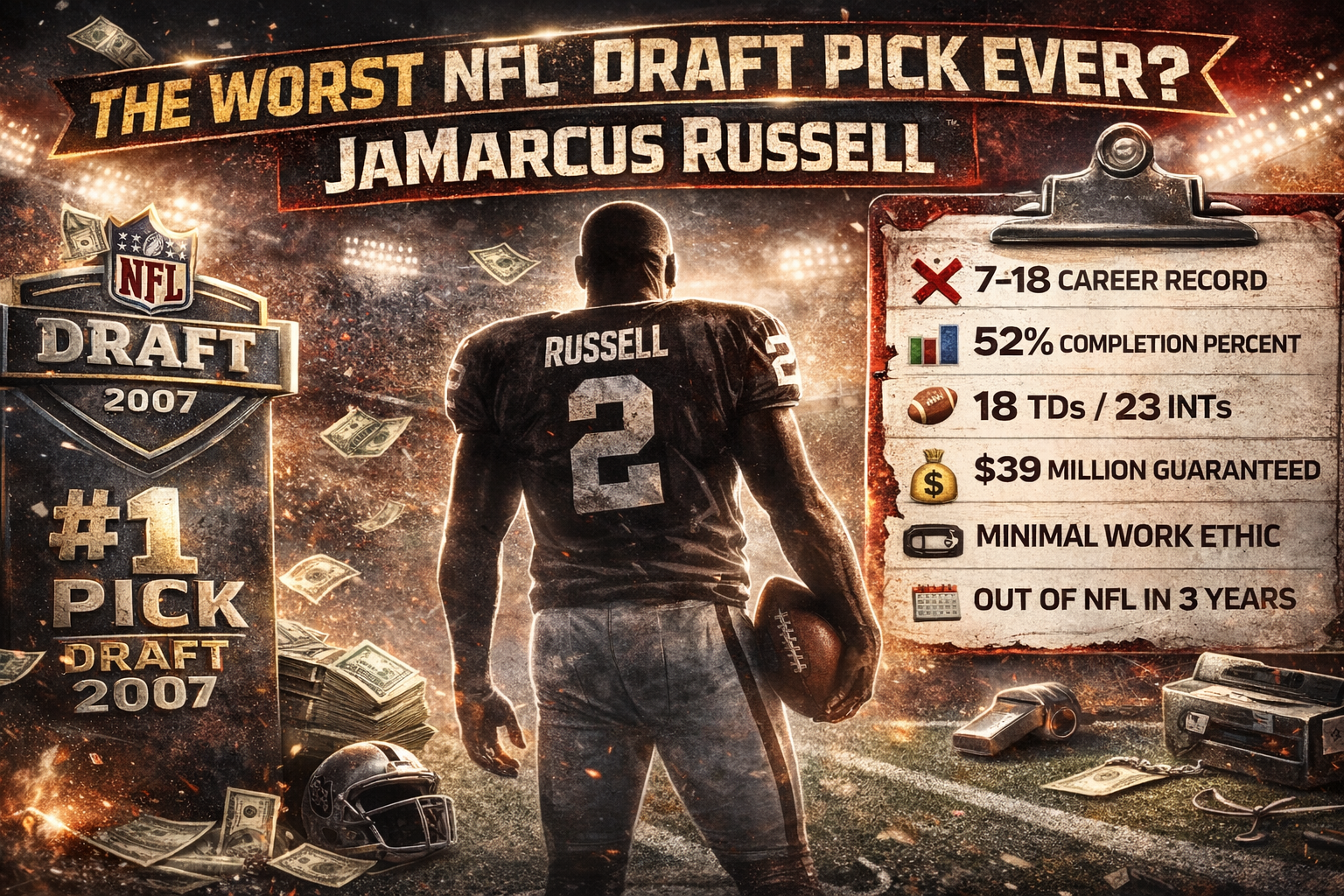
In the 2007 NFL Draft, the Oakland Raiders selected JaMarcus Russell with the #1 overall pick.
📏 Size: 6’6” (198 cm)
💪 Arm strength: Elite (could throw 60+ yards effortlessly)
🏈 College success: National champion at LSU
Scouts believed Russell had franchise quarterback potential. Instead, he became a cautionary tale.
📉 Career Statistics That Shock Fans
Across just three NFL seasons, Russell posted numbers that are historically poor for a No.1 pick:
❌ Career Record: 7 wins – 18 losses
📊 Completion Percentage: 52%
🎯 Touchdowns: 18
🚫 Interceptions: 23
📉 Passer Rating: 65.2
For comparison, the league average quarterback rating during that era was above 80.
🚨 The Real Problem: Work Ethic
Former coaches and teammates later revealed a shocking truth:
🧠 Russell frequently skipped film study
📼 Coaches gave him blank tapes — he claimed he watched them anyway
⚠️ Conditioning issues became obvious mid-season
Talent alone wasn’t enough — and Russell never adapted to the professional level.
💰 Massive Contract, Minimal Return
JaMarcus Russell signed a $68 million contract, with $39 million guaranteed — one of the largest rookie deals ever at the time.
He was released after just three seasons, making him one of the most expensive mistakes in NFL history.
🧠 Why Experts Call Him the Worst Ever
Many players underperform — but Russell checks every box that defines a historic failure:
❌ #1 overall pick
❌ Franchise-altering expectations
❌ Poor on-field results
❌ Lack of effort and preparation
❌ Long-term damage to the team
Even decades later, analysts still use his name as a warning during draft season.
🔄 What the NFL Changed Because of Him
Russell’s failure helped accelerate major changes in the league:
📜 Rookie wage scale implemented
📉 Fewer massive guaranteed rookie contracts
🔍 More focus on mental preparation during scouting
In a strange way, his career helped protect future teams from repeating the same mistake.
📊 Final Verdict
JaMarcus Russell wasn’t the least talented player to ever step onto an NFL field — but he may be the clearest example of how talent without discipline fails.
That’s why, year after year, fans continue to ask the same question:
Was JaMarcus Russell the worst NFL player of all time?
For many, the answer remains a clear and uncomfortable yes.
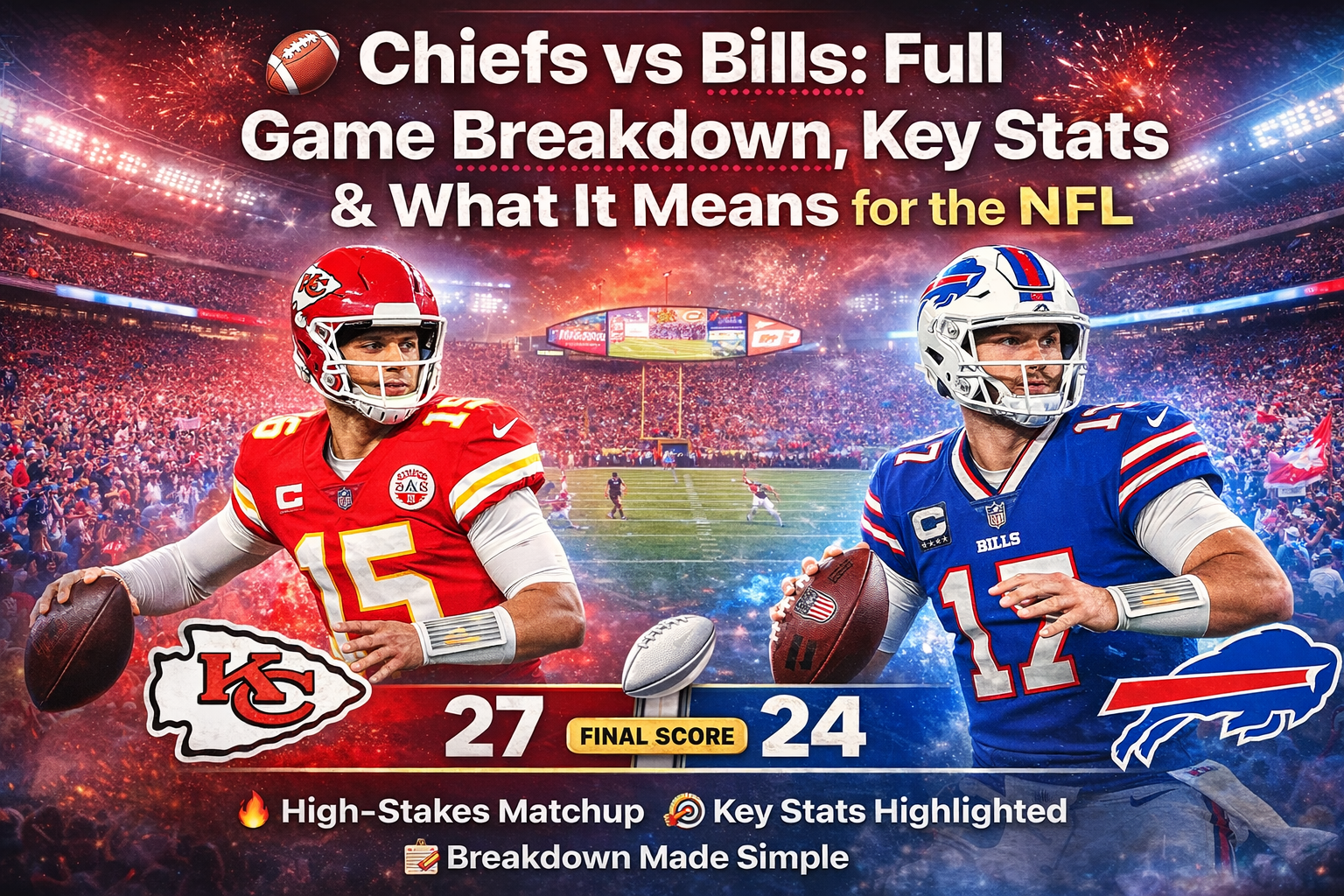
The Kansas City Chiefs and Buffalo Bills delivered another high-intensity NFL showdown, packed with elite quarterback play, critical defensive moments, and playoff-level intensity. Here’s a complete and easy-to-understand breakdown of what happened — and why it matters.
🔥 Final Score & Game Overview
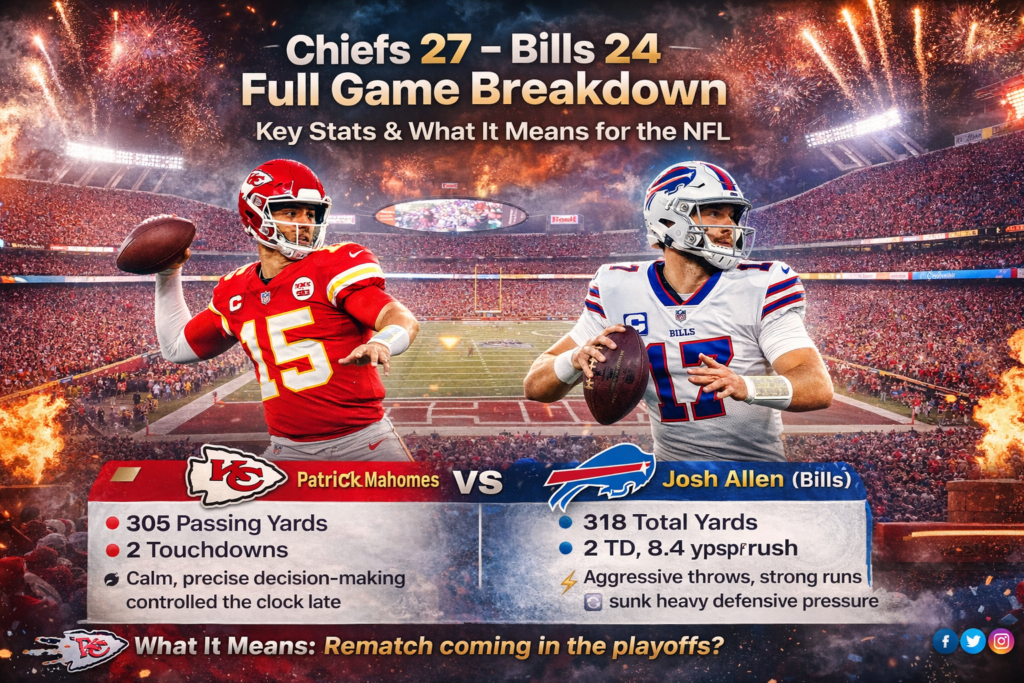
📊 Final Score: Chiefs 27 – Bills 24 📍 Location: Arrowhead Stadium ⏱️ Game Type: High-stakes AFC matchup
The game stayed close from start to finish, with both teams trading big plays and momentum swings. It felt like a playoff preview rather than a regular-season game.
🧠 Quarterback 1vs1 Comparison
Patrick Mahomes (Chiefs) vs Josh Allen (Bills)
🏈 Mahomes: Calm, precise, elite decision-making under pressure
💪 Allen: Aggressive throws, strong running impact, high-risk plays
Mahomes controlled the tempo late in the game, while Allen kept Buffalo alive with explosive plays but faced heavier defensive pressure.
While quarterbacks headline the matchup, role players quietly shaped the outcome.
🗣️ Fan & Media Reaction
🗨️ Fans praised the game as “one of the best matchups of the season.” 📰 Analysts highlighted the composure difference in late-game execution.
This game reinforced why these two teams are always part of the Super Bowl conversation.
📈 What This Means Going Forward
📌 Chiefs reaffirm AFC dominance
📌 Bills remain contenders but must clean up late mistakes
📌 Expect a rematch with playoff implications
🔮 Final Takeaway
This wasn’t just another regular-season game — it was a statement. The Chiefs showed why experience matters. The Bills showed they’re close — but not finished.
Matchups like this are why NFL fans keep watching every snap.
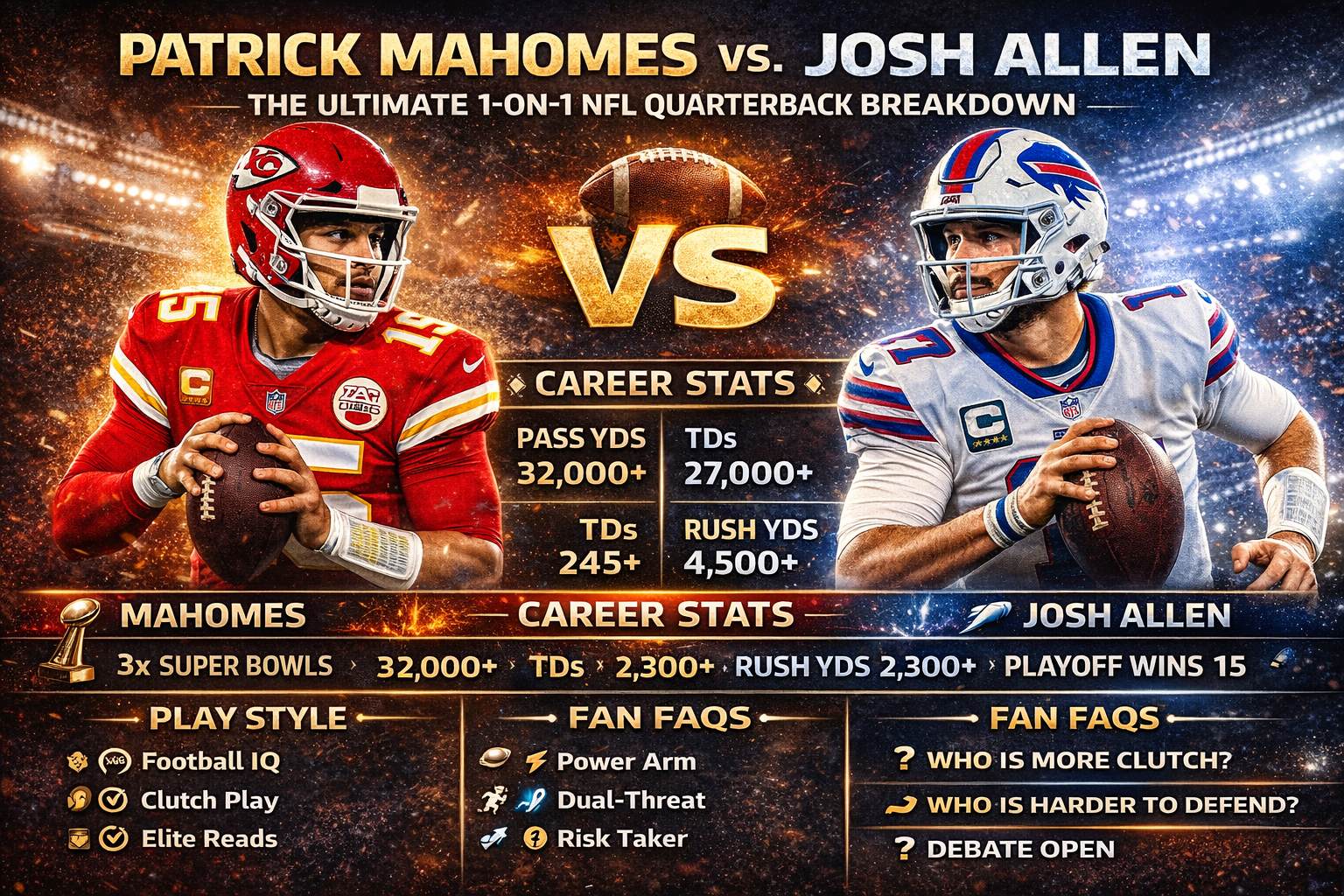
When NFL fans debate the best quarterback of the modern era, two names dominate the conversation: Patrick Mahomes and Josh Allen. This is not just a rivalry — it’s a clash of styles, efficiency, power, and leadership.
Below is the most complete 1-vs-1 breakdown with real stats, play style analysis, and future projections.
🟡 Player Profiles
Patrick Mahomes – Kansas City Chiefs
📅 Age: 29
📏 Height / Weight: 6’2″ / 225 lbs
🏈 Draft: 2017 – Round 1, Pick 10
🧠 Known for: Vision, improvisation, accuracy
Josh Allen – Buffalo Bills
📅 Age: 28
📏 Height / Weight: 6’5″ / 237 lbs
🏈 Draft: 2018 – Round 1, Pick 7
💪 Known for: Power arm, rushing ability, toughness
📊 Career Stats Comparison (Regular Season)
Category
Mahomes
Allen
Passing Yards
32,000+
27,000+
Passing TDs
245+
210+
Interceptions
70+
75+
Completion %
66.5%
63.1%
Passer Rating
103+
92+
Rushing Yards
2,300+
4,500+
Rushing TDs
14
53+
🏆 Team Success & Awards
Patrick Mahomes
🏆 Super Bowls: 3
🎖 Super Bowl MVPs: 2
⭐ NFL MVPs: 2
🏟 Playoff Record: Elite consistency
Josh Allen
🏆 Super Bowls: 0
⭐ MVP finishes: Top 5 multiple seasons
🏟 Playoff Record: Strong but inconsistent
🔥 Head-to-Head Matchups
Mahomes and Allen have faced each other multiple times, including unforgettable playoff battles.
📌 Mahomes leads overall head-to-head
📌 Allen has delivered some of the most dominant individual performances
📌 Playoff games often decided by final possessions
Key takeaway: When they face each other, the margin is razor-thin.
🧠 Play Style Comparison
Mahomes Style
🎯 Elite accuracy under pressure
🌀 Unpredictable throws & angles
🧩 Reads defenses faster than most QBs
Allen Style
💥 Strongest arm in the NFL
🏃 QB-run threat every down
⚠ High-risk, high-reward mentality
📉 Weaknesses (Rarely Discussed)
Mahomes
⚠ Occasionally extends plays too long
⚠ Relies heavily on offensive creativity
Allen
⚠ Turnover-prone in high-pressure moments
⚠ Physical style increases injury risk
🔮 Who Wins the 1-vs-1 Debate?
If you value championships and efficiency → Mahomes wins.
If you value raw power and athletic dominance → Allen has the edge.
The reality? The NFL is better because both exist.
❓ Fan FAQs
Who is more clutch?
Mahomes has a stronger late-game playoff resume.
Who is harder to defend?
Allen due to his rushing threat and deep-ball power.
Who will age better?
Mahomes’ play style is more sustainable long-term.
📌 Final Verdict
This 1-vs-1 is not about who is “better” — it’s about what kind of quarterback you want to build around.
🏆 Mahomes = Dynasty QB
🔥 Allen = Chaos & Power QB
Either way, NFL fans are witnessing a golden era of quarterback play.